
Palm Bay, FL · Garage Door Service
Is Your Palm Bay Garage Door Worth Fixing, or Done
Palm Bay's housing mostly dates to 1966-2003, median 1987. Here's how that age and the area's mild climate decide whether your door is worth repairing or replacing.
- Repairs & new doors
- Springs & openers
- Serving 5 nearby communities
When to Call Someone
If your door is slow to open, grinding, or one side drops faster than the other, that's a job for a call, not a YouTube fix. Palm Bay's housing stock mostly went up between 1966 and 2003, with the median build year around 1987 - so a lot of doors in this area are running original torsion springs and rollers that are pushing 35 years old. Springs don't give much warning. They cycle thousands of times a year, and when one lets go on a double door, the other side can't hold the weight alone. That's not a lubricate-and-wait situation.
Also call if the opener is from the same era as the house. A builder-grade chain-drive opener from the late 1980s doesn't have the safety reversal sensors required in openers made after 1993, and parts for that generation aren't something we stock - lead time on some older opener boards runs longer than people expect. If the opener is that old, we'll tell you straight whether it's worth sourcing a part or just replacing the unit. We don't pad out a repair ticket just to avoid saying 'replace it.'
Where People Go Wrong
The most common mistake we see across Palm Bay's older neighborhoods - the ones built through the 1980s and 90s that make up most of the area's 14 named sections - is treating a noisy door as a lubrication problem when it's actually a hardware problem. WD-40 on a worn roller track doesn't fix a track that's bent from thirty years of a door running slightly off-square. It just quiets it down for a week.
The second mistake is replacing one spring on a double-spring door. If the house dates to the builder-grade era most of this area was built in, both springs went in at the same time and they wear down together. Replace one and the other usually fails within months, often at a worse moment. We replace both, every time, on a two-spring setup.
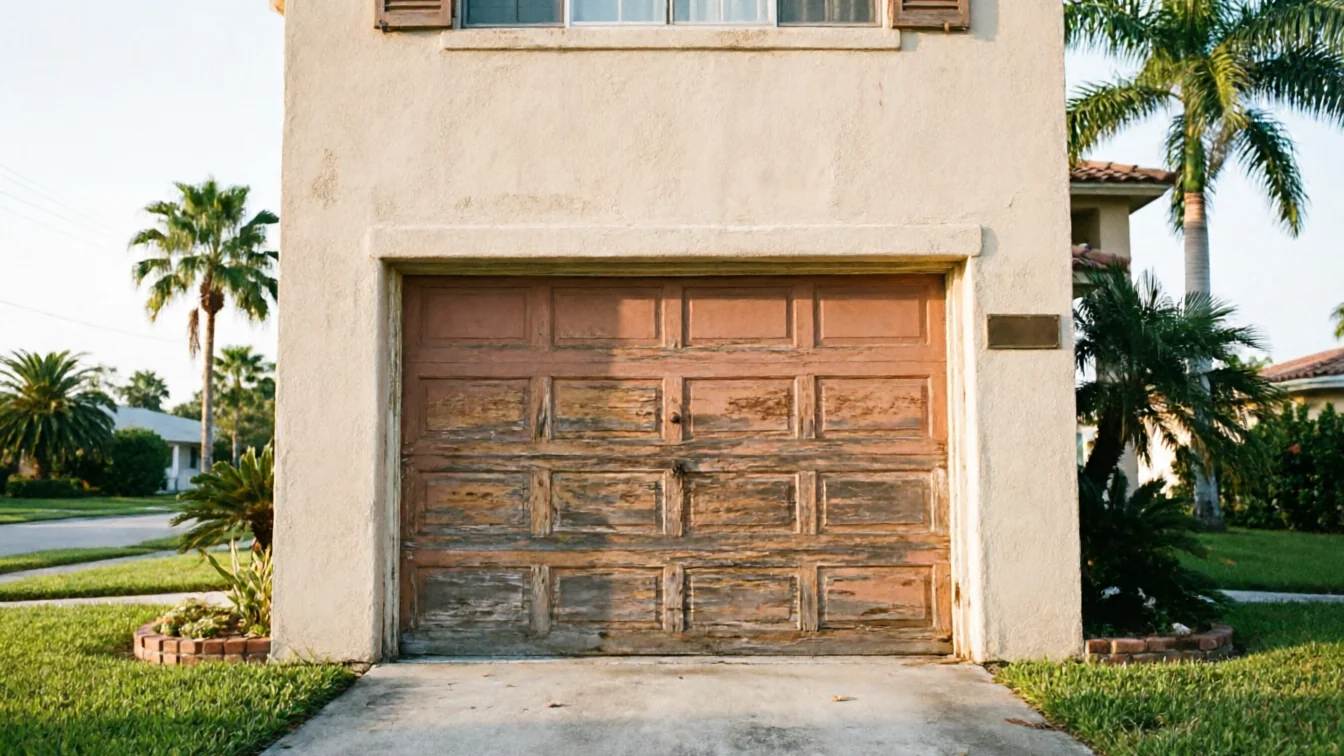
The third: assuming a 1980s steel door needs an identical replacement. A lot of those original panels are non-insulated single-layer steel, and that's not a code requirement here - it's just what builders used in that era. If you're replacing anyway, there's no reason to match the old spec unless you want to.
What Is Going On
With a median build year of 1987 across the area, and 31,251 owner-occupied houses concentrated in that same 1966-2003 window, a large share of Palm Bay's garage doors are mechanically original or on their second opener at most. Torsion springs are rated for a cycle count, typically somewhere around 10,000 open-and-close cycles, and a door used twice a day hits that number in roughly 14 years. A door built in the 1987 median year has gone through that two or three times over without anyone touching the springs.
What that means in practice: the spring may still be holding, technically, but the steel has fatigued and the failure, when it comes, tends to be sudden rather than gradual. Rollers and hinges on doors from that build era are often the original galvanized steel too, not the sealed-bearing nylon rollers that came later, so they're louder and wear the track faster. None of this is a sign of a bad install back in the day - it's just thirty-plus years of cycles on hardware that was never meant to last a lifetime.
What the Weather Here Does to It
Palm Bay sits in a mild temperate climate band, which actually works in your favor compared to places that get hard freezes - you're not dealing with the ice-cracked weatherstripping or seized openers that come from repeated freeze-thaw cycles. That's a real advantage and it means a door here can run longer on its original hardware than one up north.
But mild and steady isn't the same as dry. Consistent year-round humidity is harder on exposed steel hardware - springs, hinges, the bolts holding the track to the jamb - than an occasional cold snap is. Rust doesn't happen in dramatic bursts here; it happens slowly and evenly, and it tends to go unnoticed until a hinge or end bearing plate is thin enough to fail. On a door that's already from the 1980s or 90s building wave, that slow corrosion is usually the deciding factor in whether we recommend a repair or tell you the door's done. A sound 35-year-old door with surface rust is often still worth fixing. One with rust through the end plates isn't.
Frequently asked questions
How old does a garage door have to be before replacing it makes more sense than repairing it?
There's no fixed age, but if your door dates to Palm Bay's typical 1966-2003 building wave and you're now looking at a second or third repair - spring, then rollers, then the opener - the repairs add up to more than a new door costs. We'll always quote the repair first and tell you if we think it's not worth it.
Why did both springs on my double garage door break around the same time?
Builder-grade doors from the 1980s and 90s typically had both springs installed together, and they wear down together too. If one goes, the other is usually close behind. We replace both on a two-spring setup rather than just the one that failed.
Does Palm Bay's climate mean garage door hardware rusts faster than other places?
The mild temperate climate here spares you the freeze-thaw damage that cracks seals and seizes openers elsewhere. What it does instead is slow, steady humidity-driven rust on exposed steel hardware, which matters most on doors that are already decades old.
Related garage door services in Palm Bay
More garage door guides
Book garage door service in Palm Bay
Call now or request a quote - tell us what the door is doing and where you are.